Gilt Frames, Cardboard Cards and a Tesla: Art World Marbella Lays the Coast Bare
The Costa's biggest international art fair fills the Palacio de Congresos with 5,000 works, 80 countries and the unmistakable scent of ambition — and somewhere in the crowd, something real.
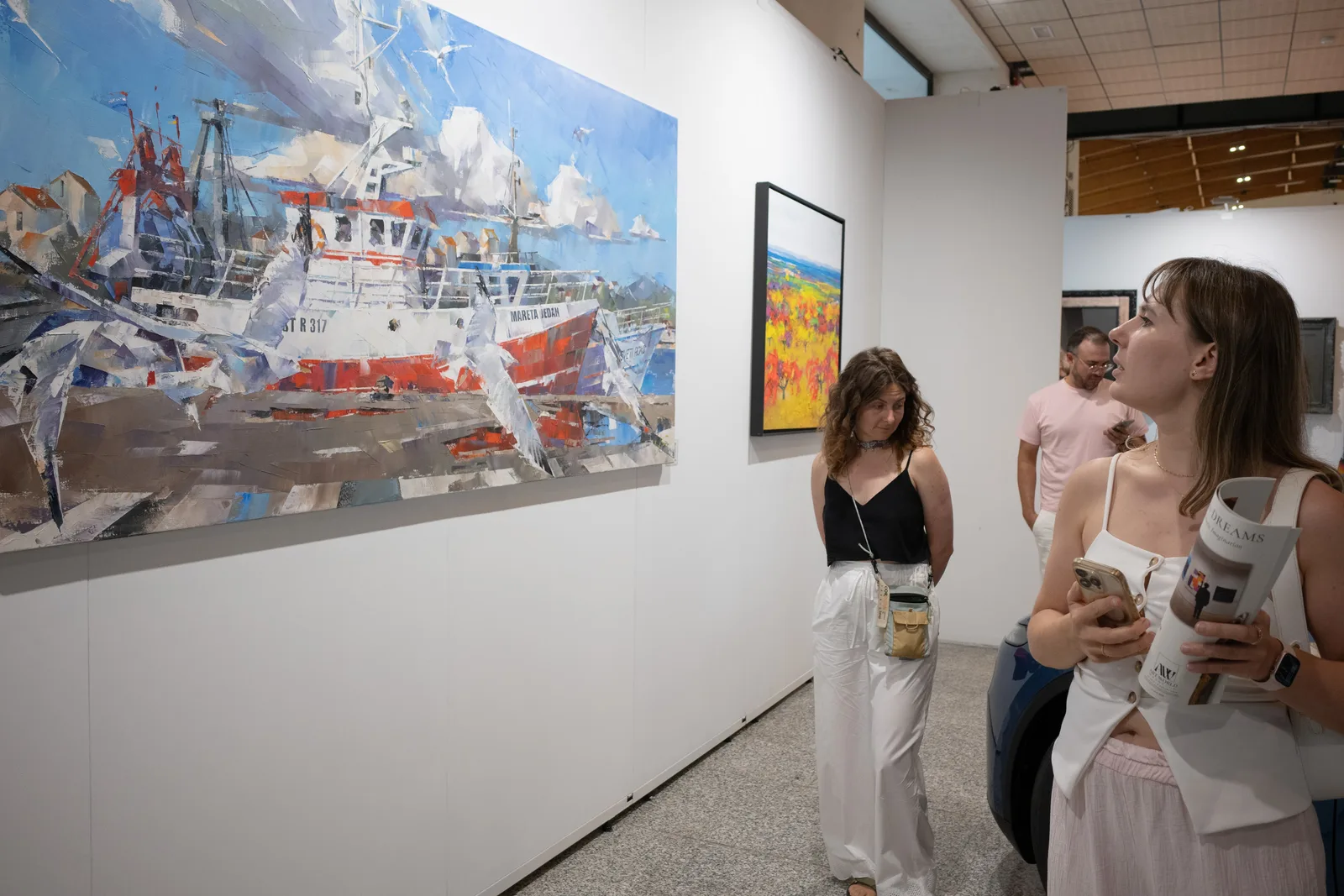
The air conditioning at the Palacio de Congresos Adolfo Suárez works hard. It has to. Outside, Marbella in late July is a kiln. Inside, eighty-plus exhibitors from six continents have laid claim to their patches of marble floor and temporary wall, and the heat they generate is of a different order — commercial, cultural, occasionally genuine.
Art World Marbella runs 30 July to 2 August, and its organisers will tell you it is a strategic meeting point between art, luxury and the international market. They are not wrong. They are also underselling it. A fair like this is a diagnostic scan of the coast itself: hold it up to the light and you see who lives here, who visits, who buys, and what they believe beauty is.
The Bazaar of Nations
Walk the floor and you can play a parlour game of national stereotypes — unfair, reductive, and irresistible.
The oligarchs and their decorators gravitate towards large canvases with a certain gilt-edged opulence: heavy impasto, swirling mythological figures, frames that could anchor a yacht. This is Marbella, after all. The market provides what the market demands, and on the Golden Mile the demand skews monumental.
Then there are the others — the ones who move through the fair like divers reading a reef. Slow. Lateral. Attuned to currents the rest of us miss. They stop where nobody else stops. They lean close. They feel the texture of a surface before they register its subject, sense the weight of a pigment the way a sommelier noses a glass. Watch them long enough and you realise they are not collecting at all. They are listening. The canvas hums at a frequency most of us never tune to, and these people hear it the way certain dogs hear whistles — not because they are trained but because they are built for it. Seeing, for them, is a different verb entirely, richer and stranger, and a fair like this gives them room to practise it.
Corners Worth Finding
The fair’s geography rewards the wanderer who drifts past the prime-position stands.
Tucked behind a Tesla display stand — the car, not the man, though the juxtaposition would have amused him — the Kyiv-based gallery Art Victory shows a clutch of Ukrainian painters whose work carries the discipline of people who have earned the right to it. Marine subjects dominate: ships, open water, the restless architecture of waves. Volodymyr Glukhomanyuk’s canvases are especially fine — stylish, assured, the sea rendered not as backdrop but as protagonist. That these artists are here at all, exhibiting while their country endures what it endures, is a fact that needs no editorial inflation. The paintings speak. Look at them.
Romania is represented by Dragoste — the gallery name means “love” in Romanian, which is either a statement of intent or a dare. Its founder, Dan-Raul Pintea, is a singular figure: Sibiu-trained, wilfully contradictory, impossible to ignore. He runs a 5-square-metre gallery on Strada Andrei Șaguna, three walls and a window to the street, lit by a red neon that spells the word he has built his practice around. He hands out business cards cut from a cardboard box, and the gesture is either performance art, radical honesty, or both. Find his stand. Give him ten minutes. Let him explain the work. The cardboard cards are, in their way, the most memorable objects at the entire fair.
Swedish photographer Greenleaves Andersson is among the confirmed exhibitors, and her work does something rare: it carries the Swedish landscape into the room — Småland forests, Öland light, water and stone from a country that hoards its sunshine and spends it carefully. The images are precise, luminous, meditative. A Nordic eye, trained on Nordic ground, set down here among the terracotta and the glare. The contrast does something useful: it reminds you that light is not one thing, that a photographer who has learned patience from short winter days sees differently. There is movement in the stillness of these images, a quality that deepens on a second viewing. Ask about the process. You will get an answer worth the asking.
Bālta gallery brings a darker register to the floor. A cold draught through sun-bright rooms. Where much of the fair trades in warmth and Mediterranean gold, Bālta’s canvases run to storm-light and shadow — turbulent skies, seas that threaten rather than invite, horizons that lower like a warning. The effect is arresting. You round a corner expecting more terracotta warmth and walk instead into weather: paint that carries the weight of a squall line, colour that remembers what the coast looks like when the pleasure boats stay in port. It is a useful corrective. The postcards sell perpetual noon, but the sea has moods the tourist brochures leave out, and Bālta’s painters know every one of them.
What the Fair Is
Over five thousand artworks across four days. Free admission. Six hundred artists. Not all of it will move you. A fair this size cannot avoid spectacle, cannot dodge the transactional hum, the champagne-and-lanyard rituals of the opening VIP night. Some of the work is magnificent. Some is furniture. Some is the kind of thing that looks perfect above a sofa in a Puerto Banús penthouse, and there is nothing wrong with that, provided nobody pretends it is something else.
But here is what matters: somewhere between the gilt frames and the Tesla, between the cardboard business cards and the canvases that catch the Andalusian light even under halogen tubes, something will stop you. Every visitor finds something different. Every visitor, if they are patient and willing to be surprised, finds something true.
Walk the whole floor. Talk to the artists. Let the Romanian with the cardboard cards explain his work. Something here is meant for you.
Art World Marbella. Palacio de Congresos Adolfo Suárez, Calle José Meliá 2, Marbella. 30 July – 2 August 2026. Admission free.